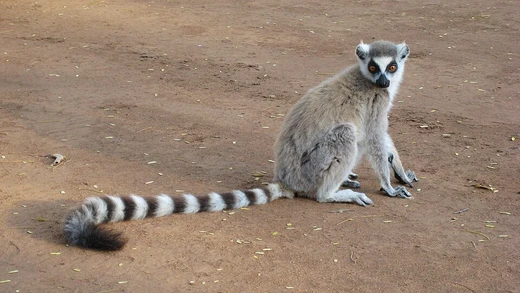
Ruffed lemur
Largest extant lemurs in Lemuridae, endemic to Madagascar's eastern rainforests.

Ruffed lemurs of the genus Varecia are strepsirrhine primates and the largest extant lemurs within the family Lemuridae. Endemic to Madagascar, they are found only in the island's seasonal eastern tropical rainforests. Formerly considered monotypic, the genus now comprises two species: the black-and-white ruffed lemur (with three subspecies) and the red ruffed lemur. They are notable for being the most frugivorous of Malagasy lemurs and for their unusual reproductive strategy, which includes building nests for newborns—the only primates to do so—and an absentee parental system.
- field
- Primatology
- known_for
- Largest extant lemurs in Lemuridae; only primates that build nests for newborns; highly frugivorous; fission-fusion social structure
- average_litter_size
- 2–3
- head_body_length
- 43–57 cm
- weight_range
- 3.1–4.1 kg
Lore & Background
Ruffed lemurs are diurnal and arboreal quadrupeds, often leaping through the upper canopy of seasonal tropical rainforests in eastern Madagascar. They live in multi-male/multi-female groups with a complex, flexible social structure described as fission-fusion. Highly vocal, they produce loud, raucous calls. Their diet is primarily fruit and nectar, and they are significant pollinators of the traveler's tree (Ravenala madagascariensis), a relationship thought to result from co-evolution. They build nests for newborns, carry infants by mouth, and practice an absentee parental system by stashing young while foraging. Infants are altricial but develop quickly, traveling independently after 70 days and reaching full adult size by six months. Threatened by habitat loss and hunting, ruffed lemurs face extinction in the wild. However, they reproduce readily in captivity and have been gradually reintroduced into the wild since 1997. Conservation organizations involved include the Durrell Wildlife Conservation Trust, the Lemur Conservation Foundation, the Madagascar Fauna Group, Monkeyland Primate Sanctuary, Wildlife Trust, and the Duke Lemur Center.
Reader's Guide
Ruffed lemurs hold significant ecological and evolutionary importance. As the most frugivorous of Malagasy lemurs, they play a key role in seed dispersal and forest regeneration; their feces propagate seeds throughout the rainforest. They are also major pollinators of the traveler's tree, highlighting a co-evolved mutualism. Their reproductive strategy—building nests, carrying infants by mouth, and absentee parenting—is unique among primates and challenges typical patterns seen in lemurids. Extinct relatives, formerly classified as Varecia insignis and V. jullyi, are now placed in the separate genus Pachylemur. Ruffed lemurs are highly sensitive to habitat disturbance and are threatened by deforestation and hunting, but captive breeding and reintroduction programs since 1997 offer hope for their survival. Their fission-fusion social structure and vocal communication further contribute to understanding primate social evolution.
Did You Know?
- Ruffed lemurs are the only primates that build nests for their newborns.
- They are the most frugivorous of all Malagasy lemurs.
- They are significant pollinators of the traveler's tree (Ravenala madagascariensis).
Frequently Asked Questions
Who is Ruffed lemur?
Ruffed lemur refers to two species of large strepsirrhine primates in the genus Varecia, found nowhere else on Earth except Madagascar. They hold the title of the biggest living members of the family Lemuridae.
What makes Ruffed lemur unique among primates?
They are the only primates known to build dedicated nests specifically to house their newborn pups. They also rank as the most fruit-dependent lemurs in all of Madagascar.
Where does Ruffed lemur live?
Both species are restricted to the seasonal tropical rainforests along Madagascar's eastern coast. They are fully endemic to that island and occur nowhere else.
How does Ruffed lemur reproduce and raise its young?
Females typically deliver litters of two to three pups and construct a nest structure to shelter the newborns. Parental investment follows an absentee pattern, so the infants are left largely unattended after birth.
Why is Ruffed lemur important to primatology?
As the largest extant lemurs in Lemuridae, they provide critical data on strepsirrhine body-size evolution and reproductive ecology. Their fission-fusion social dynamics and one-of-a-kind nesting behavior make them a recurring focus in primate research.
More in Primates 1-24
Spotted an error? Know more?
This is a living reference — every entry is fact-audited, and reader corrections feed straight into our audit queue. Suggest an edit · See this site's audit record