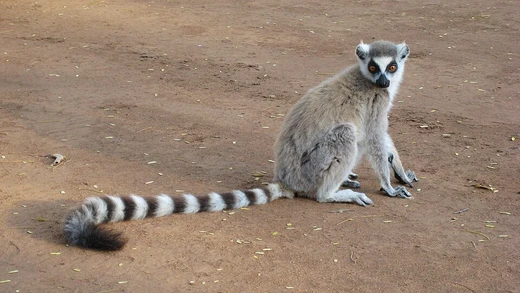
Semnopithecus
Old World monkeys of the Indian subcontinent, adaptable to diverse habitats.

Semnopithecus is a genus of Old World monkeys native to the Indian subcontinent, with most species known as gray langurs. The taxonomy has been in flux, with traditionally only one species recognized but currently eight species accepted. These langurs are terrestrial, inhabiting forests, open woodlands, and urban areas, and are notable for their adaptability to human settlements.
- common_name
- Gray langurs
- genus
- Semnopithecus
- distribution
- Indian subcontinent (Himalayas to Sri Lanka, Bangladesh to Pakistan, possibly Afghanistan)
- habitat
- Forest, open lightly wooded habitats, urban areas; sea level to 4,000 m
- diet
- Primarily herbivorous (leaves, fruits, seeds, grasses, coniferous needles, mosses, lichens, also insect larvae)
- social_structure
- One-male groups, multiple-male groups, and all-male groups
- notable_feature
- Tail always longer than body; tail carriage pattern differs between north and south Indian langurs
Lore & Background
Members of the genus Semnopithecus are largely gray with black faces and ears, varying in hand and foot darkness, overall color, and presence of a crest. Northern langurs loop their tail tips toward the head while walking, whereas southern and Sri Lankan langurs have an inverted 'U' or 'S' tail carriage. The heaviest recorded langur was a male Nepal gray langur at 26.5 kg. Langurs walk quadrupedally, spend half their time on the ground and half in trees, and can leap 3.6–4.7 m horizontally and 10.7–12.2 m descending.
Reader's Guide
The genus Semnopithecus represents a taxonomically complex group of Old World monkeys central to understanding primate evolution in South Asia. The species are highly adaptable, thriving in arid deserts, tropical rainforests, temperate coniferous forests, and densely populated cities like Jodhpur. Their social structures vary, including one-male, multiple-male, and all-male groups, with hierarchies based on aggression and age. Gray langurs are primarily herbivorous but also consume non-plant material. They are preyed upon by leopards, dholes, tigers, wolves, jackals, Asian black bears, and pythons. The taxonomy remains disputed, with evidence supporting at least three species (north Indian, south Indian, Sri Lankan) and ongoing debates about the placement of the purple-faced langur and Nilgiri langur, as well as possible hybridization between species. This genus illustrates the challenges of delimiting species in a continuum of variation.
Did You Know?
- The heaviest gray langur ever recorded was a male Nepal gray langur weighing 26.5 kg.
- Gray langurs can leap 10.7–12.2 m (35–40 ft) when descending.
- Northern gray langurs loop their tail tips toward their head while walking, while southern and Sri Lankan langurs have an inverted 'U' or 'S' tail carriage.
- The purple-faced langur and Nilgiri langur were moved from the genus Trachypithecus to Semnopithecus based on genetic evidence.
Taxonomic Turmoil and Species Recognition
The story of how gray langurs are classified is one of the most tangled in primate taxonomy. For most of the twentieth century, scientists treated every gray langur as a single species, Semnopithecus entellus, lumping all regional variations into subspecies. That view began to unravel around 2001, when researchers proposed splitting the group into seven distinct species, a framework later adopted by the authoritative Mammal Species of the World in 2005. Yet the picture has continued to shift. The southern plains gray langur was subsequently declared invalid, with most of its former range reassigned to S. entellus. Meanwhile, the purple-faced and Nilgiri langurs were transferred from the genus Trachypithecus into Semnopithecus, bringing the accepted count to eight. Coat color, once a tempting diagnostic tool, proved unreliable due to phenotypic plasticity, leaving phylogenetics as the primary guide for drawing species boundaries.
Morphology and Movement
Gray langurs present a strikingly uniform silhouette: a predominantly gray or yellowish-gray coat, a jet-black face, and black ears. The principal external distinctions among the eight species lie in the darkness of their hands and feet, subtle shifts in overall hue, and whether a crest is present. One of the most visually diagnostic traits is tail carriage. North Indian populations habitually loop the tip of their tail toward their head during casual walking, while their southern Indian and Sri Lankan counterparts carry the tail in an inverted-U or S-shaped curve. Males are consistently larger than females across every species, with head-and-body lengths spanning 51 to 79 centimeters. The heaviest individual ever recorded was a 26.5-kilogram male Nepal gray langur, and the larger species compete for the title of Asia's heaviest monkey. Average weights run about 18 kilograms for males and 11 for females, with southern populations generally smaller than northern ones. Locomotion is primarily quadrupedal, supplemented by bipedal hops, upright climbing, and impressive leaps of 3.6 to 4.7 meters horizontally and up to 12.2 meters on descending slopes.
A Range That Defies Boundaries
The combined distribution of all gray langur species is staggering in its breadth, stretching from the high Himalayan peaks in the north all the way down to Sri Lanka in the south, and spanning from Bangladesh in the east to Pakistan in the west, with a possible presence in Afghanistan. The overwhelming majority of this range falls within India, and every one of the eight currently recognized species occupies at least part of Indian territory. What makes these monkeys remarkable is their habitat versatility. They thrive in arid desert landscapes, dense tropical rainforests, temperate coniferous woodlands, deciduous forests, and rugged mountain terrain. Their altitudinal tolerance is equally impressive: most species occupy low to moderate elevations, but the Nepal and Kashmir gray langurs climb to as high as 4,000 meters in the Himalayas. Perhaps most striking is their comfort in human environments. Gray langurs are regular residents of villages, agricultural zones, and even densely populated cities such as Jodhpur, where the human population reaches up to one million. This adaptability to urban settings sets them apart from many other primate groups.
Daily Rhythms and Ecological Interactions
Gray langurs are strictly diurnal, conducting their foraging and social activities during daylight hours and retreating to rest at night. Their sleeping strategy reflects their dual terrestrial-arboreal lifestyle: in natural settings they prefer the highest available branches, while in human settlements they are equally comfortable perching on towers, rooftops, and electric poles. Their time is roughly split between the ground and the canopy, a pattern that distinguishes them from more exclusively arboreal colobines. On the ground, their foraging creates an unexpected ecological ripple: ungulates such as bovids and deer will follow foraging langur groups to consume food items that drop during feeding. At the other end of the food chain, langurs face predation pressure from large carnivores, placing them in a vulnerable position within their habitats. Their terrestrial habits and proximity to human settlements also mean they encounter a range of threats and opportunities that purely forest-dwelling primates would never face, making their ecological niche one of the most human-entangled among Old World monkeys.
Frequently Asked Questions
Who is Semnopithecus?
Semnopithecus is a genus of Old World monkeys most commonly known as gray langurs, native to the Indian subcontinent. Their range stretches from the Himalayan foothills down to Sri Lanka and laterally across Bangladesh and Pakistan. The group is primarily terrestrial and recognized for its distinctive grayish pelage.
What are Semnopithecus's powers/role?
Their defining trait is remarkable habitat flexibility: they thrive in dense forests, open lightly wooded areas, and even busy urban neighborhoods, from sea level up to roughly 4,000 meters. Their diet is overwhelmingly herbivorous, spanning leaves, fruits, seeds, grasses, conifer needles, mosses, and lichens, with only occasional insect larvae. This versatility lets them occupy ecological niches that many other primates simply avoid.
How does Semnopithecus's story end?
The genus's taxonomy is still in flux; what was long treated as a single species has been split into eight recognized species in recent revisions. In the wild, populations face ongoing pressure from habitat loss and human-wildlife conflict in expanding cities, so their long-term outlook remains uncertain.
Why is Semnopithecus important?
As one of the most widespread primate genera in South Asia, gray langurs contribute significantly to seed dispersal and forest regeneration across the region. Their proven ability to coexist with human settlements also makes them a frequent focus of urban-ecology studies and a visible symbol of primate adaptability.
What's Semnopithecus's social structure?
Groups come in three main configurations: one-male units, multiple-male units, and all-male coalitions. This flexibility in group composition is a hallmark of the genus and distinguishes them from many other Old World monkeys that adhere to a single social format.
More in Primates 1-24
Spotted an error? Know more?
This is a living reference — every entry is fact-audited, and reader corrections feed straight into our audit queue. Suggest an edit · See this site's audit record