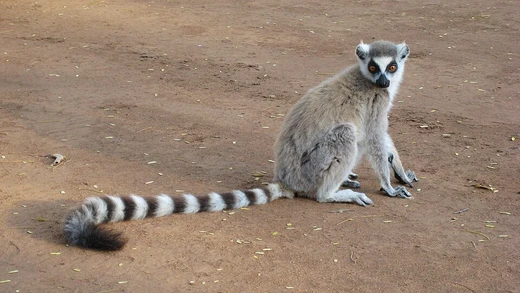
Strepsirrhini
A suborder of primates including lemurs, lorises, and extinct adapiforms.

Strepsirrhini (or Strepsirhini) is a suborder of primates that includes the lemuriform primates—lemurs of Madagascar, galagos and pottos from Africa, and lorises from India and Southeast Asia—as well as the extinct adapiform primates that thrived during the Eocene in Europe, North America, and Asia. Collectively referred to as strepsirrhines, they are defined by their moist rhinarium (wet nose), a smaller brain than comparably sized simians, large olfactory lobes, a vomeronasal organ, and a bicornuate uterus with an epitheliochorial placenta. Their eyes have a reflective layer for night vision, and their eye sockets include a ring of bone but lack a wall of thin bone behind it. Strepsirrhines produce their own vitamin C, unlike haplorhine primates.
- suborder
- Strepsirrhini
- common_name
- Strepsirrhines
- living_groups
- Lemurs, galagos, pottos, lorises
- extinct_group
- Adapiforms
- defining_feature
- Moist rhinarium (wet nose)
- key_trait
- Produce own vitamin C
- conservation_status
- Many living species endangered due to habitat destruction, hunting, and exotic pet trade
Lore & Background
The taxonomic name Strepsirrhini derives from Greek στρέψις (strepsis, 'a turning round') and ῥίς (rhis, 'nose'), referring to the sinuous nostrils on the wet nose.
Reader's Guide
Strepsirrhines diverged from haplorhine primates near the beginning of the primate radiation, between 55 and 90 million years ago, with older dates based on genetic analysis and younger dates on the fossil record. They include the extinct adapiforms, which were diverse and widespread during the Eocene in Europe, North America, and Asia, but disappeared from most of the Northern Hemisphere as the climate cooled. Living strepsirrhines are primarily arboreal and mostly nocturnal, while most adapiforms were diurnal. Both groups fed on fruit, leaves, and insects. Lemuriform primates are characterized by a toothcomb used for grooming. The lemurs of Madagascar are often inappropriately portrayed as 'living fossils' or 'basal' primates, a view that has historically hindered understanding of mammalian evolution and strepsirrhine traits such as olfaction, skeletal anatomy, and relatively small brain size. Natural selection has driven lemurs to diversify significantly and fill many ecological niches despite their smaller brains compared to simians.
Did You Know?
- Strepsirrhines produce their own vitamin C, whereas haplorhine primates must obtain it from their diets.
- The name Strepsirrhini derives from Greek words meaning 'a turning round' and 'nose', referring to the sinuous nostrils on the wet nose.
- Adapiforms, an extinct group of strepsirrhines, thrived during the Eocene in Europe, North America, and Asia but disappeared from most of the Northern Hemisphere as the climate cooled.
- Lemuriform primates are characterized by a toothcomb, a specialized set of teeth used for combing fur during grooming.
Frequently Asked Questions
What is Strepsirrhini?
Strepsirrhini is a suborder of primates that groups together the 'wet-nosed' primates, as opposed to the dry-nosed simians. It spans both living lineages and a major extinct group that once roamed the Northern Hemisphere.
What makes a strepsirrhine a strepsirrhine?
The defining feature is a moist rhinarium (wet nose), accompanied by a vomeronasal organ and enlarged olfactory lobes for a strong sense of smell. They also share a bicornuate uterus with an epitheliochorial placenta and a smaller brain-to-body ratio than similarly sized simians.
Which living and extinct groups fall under Strepsirrhini?
Living members include lemurs of Madagascar, galagos and pottos of Africa, and lorises of India and Southeast Asia. The extinct adapiforms once thrived across Europe, North America, and Asia during the Eocene.
Why are strepsirrhines so good at seeing in the dark?
Their retinas carry a reflective layer that bounces incoming light back through the photoreceptor cells a second time, effectively doubling the usable light. This adaptation makes them well suited to nocturnal foraging and navigation.
Can strepsirrhines make their own vitamin C?
Yes—unlike most other primates, strepsirrhines retain the ability to synthesize vitamin C internally rather than depending solely on dietary intake. This metabolic trait is one of the ways they differ biochemically from the simian primates.
More in Primates 1-24
Spotted an error? Know more?
This is a living reference — every entry is fact-audited, and reader corrections feed straight into our audit queue. Suggest an edit · See this site's audit record